In the fast-evolving digital landscape, optimizing your online presence requires more than just basic search engine strategies. Modern marketers and business owners must navigate multiple optimization frameworks to maximize visibility, engagement, and conversions. This expert playbook provides a comprehensive guide to SEO, AEO, GEO, AIO, and SXO, including definitions, differences, best practices, checklists, and practical templates for implementation.
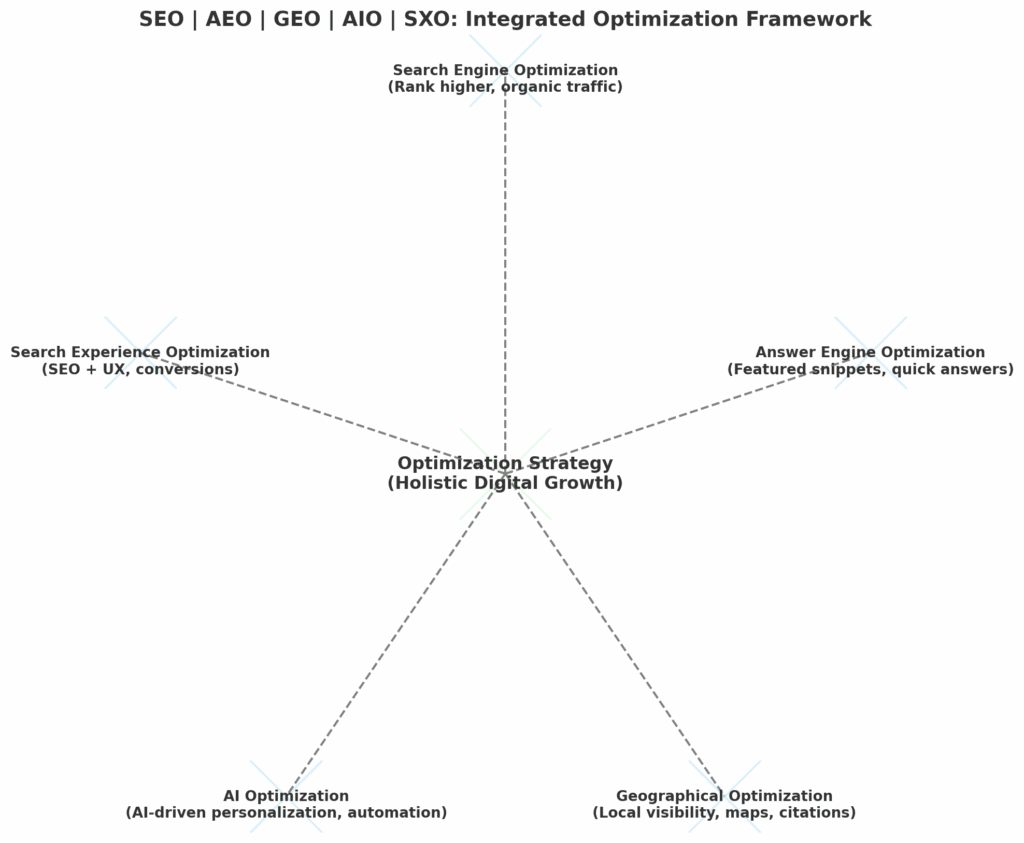
1. Understanding the Optimization Frameworks
1.1 SEO – Search Engine Optimization
Definition: SEO is the practice of optimizing a website to rank higher on search engines like Google, Bing, and Yahoo. It encompasses on-page, off-page, and technical strategies to increase organic traffic.
Key Focus Areas:
- Keywords & content
- Backlinks & authority
- Site structure & technical health
1.2 AEO – Answer Engine Optimization
Definition: AEO focuses on optimizing content to appear in direct answer results, such as Google’s “People Also Ask” boxes or featured snippets.
Key Focus Areas:
- Structured data & schema markup
- Question-focused content
- Concise and authoritative answers
1.3 GEO – Geographical Optimization
Definition: GEO ensures your digital presence is optimized for local and regional searches, connecting businesses with audiences in specific locations.
Key Focus Areas:
- Google Business Profile optimization
- Local citations and NAP consistency (Name, Address, Phone)
- Geo-targeted content and landing pages
1.4 AIO – Artificial Intelligence Optimization
Definition: AIO leverages AI technologies to optimize content, user experiences, and digital marketing strategies automatically.
Key Focus Areas:
- AI-driven content generation and personalization
- Predictive analytics for user behavior
- Chatbots and automated engagement
1.5 SXO – Search Experience Optimization
Definition: SXO combines SEO with user experience (UX), focusing on satisfying both search engine algorithms and human visitors.
Key Focus Areas:
- Website speed and mobile responsiveness
- Intuitive site navigation and layout
- Engagement metrics like dwell time and bounce rate
2. Key Differences Between Frameworks
| Framework | Focus | Goal |
|---|---|---|
| SEO | Search rankings | Organic traffic |
| AEO | Direct answers | Quick visibility in SERPs |
| GEO | Local search | Targeted regional engagement |
| AIO | AI-driven optimization | Personalization & efficiency |
| SXO | User experience + SEO | Engagement & conversion |
3. Strategy Development
3.1 Setting Goals
- Increase organic search traffic (SEO)
- Achieve featured snippet positions (AEO)
- Capture local leads (GEO)
- Enhance content relevance using AI (AIO)
- Improve on-site engagement and conversions (SXO)
3.2 Audience & Keyword Research
- Map primary, secondary, and long-tail keywords
- Include local keywords for GEO
- Use AI tools for predictive keyword opportunities
4. Technical Audit Checklist
| Task | Purpose | Tools |
|---|---|---|
| Site speed test | Improve UX & SEO | Google PageSpeed Insights |
| Mobile-friendliness check | SXO optimization | Google Mobile-Friendly Test |
| Structured data validation | AEO & SEO | Schema.org Validator |
| Crawl error analysis | SEO & SXO | Screaming Frog, SEMrush |
| Geo-location checks | GEO | Google Search Console & Maps |
5. Content Optimization
5.1 Best Practices
- Use conversational, question-oriented headings for AEO
- Include localized content and landing pages for GEO
- Incorporate AI-powered insights for AIO
- Optimize meta tags, headings, and internal links for SEO
- Ensure readability, accessibility, and mobile responsiveness for SXO
5.2 Implementation Template
Title:
Meta Description:
Primary Keywords:
Secondary Keywords:
Geo Keywords:
Structured Data Markup:
Call to Action:
Engagement Metrics to Track (SXO):
6. Measurement Frameworks
6.1 KPIs by Optimization Type
- SEO: Organic traffic, keyword rankings, backlinks
- AEO: Featured snippet impressions, click-through rates
- GEO: Local map visibility, calls, direction clicks
- AIO: AI-driven personalization accuracy, user satisfaction
- SXO: Bounce rate, dwell time, conversions
6.2 Reporting & Optimization
- Use Google Analytics, Search Console, and AI analytics platforms
- Create monthly dashboards to track performance trends
- Adjust strategies based on performance insights
7. Implementation Checklist
- Conduct a full technical SEO audit
- Identify content gaps for AEO featured snippets
- Optimize local citations and GEO landing pages
- Integrate AI tools for content personalization (AIO)
- Evaluate UX, page speed, and engagement for SXO
- Track KPIs and refine strategies monthly
Conclusion
Mastering SEO, AEO, GEO, AIO, and SXO empowers marketers and business owners to dominate search results while creating exceptional user experiences. By following this playbook, businesses can not only boost visibility but also engage audiences, generate leads, and drive sustainable growth.